
Network reliability
We’re working hard to improve network resilience and reliability in regional and remote areas of the South West Interconnected Network.
We understand the inconvenience that repeated or prolonged outages cause our customers, particularly in regional and remote areas of the South West Interconnected Network.
Our network maintenance programs are constantly improving the way assets are managed, including the 860,000 poles in the network. We’ve got a comprehensive poles and wires maintenance program and bushfire mitigation program which includes pole replacement, conductor replacements and vegetation management around our infrastructure, as well as inspection of assets in high fire risk areas.
We’re continually looking at ways to improve reliability using data and modelling, including mapping potential climate change weather impacts as well as pole top fire modelling research to improve our ability to predict periods of risk where weather may affect the network.
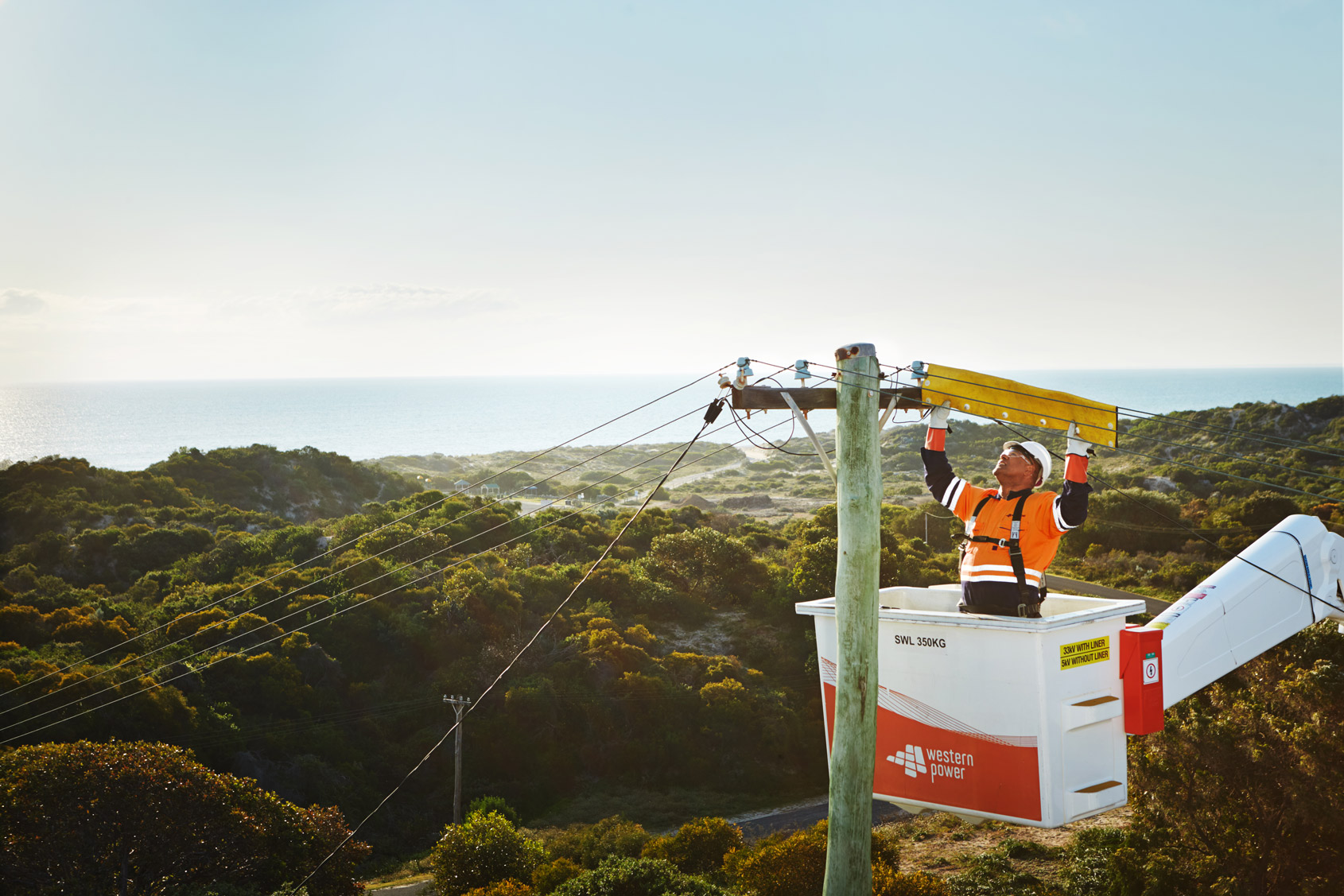
Why unplanned outages occur
Regional Western Australia presents a challenging environment to provide reliable power to our customers Due to the long distances involved, many regional towns and customers are supplied by only a single radial feeder (power line) from the substation – some of which can be up to 200km long. These lines may go through bushland and forest, across waterways, and private farmland, and may be very difficult to access. These challenges, combined with the long distances involved, means that it can take our crews a long time to locate and fix faults when they occur. These repairs may be further hindered by severe weather and fire, as our crews can’t access and restore the fault until it is safe to do so.
Localised unplanned outages are an interruption to the transmission or distribution of electricity that is unscheduled. These can be caused by storm-blown branches, wildlife, pole-top fires or bushfires anywhere along the line that trip the supply and result in an unplanned outage.
Improvements we’re making right now
In collaboration with local communities, Western Power is identifying tailored solutions that will help improve reliability in the medium to long-term.
Improvements we are making include:
- New interconnections between feeders (including normally open points) to reduce restoration times and enable backfeeding
- Installation of new Load Break Switches (LBSs) and reclosers to sectionalise long feeders and isolate faults faster
- Network reconfiguration and operability changes to reduce restoration times and enable backfeeding
- Automation of existing devices (e.g. Ring Main Units, voltage regulators and reclosers)
- Protection upgrades and optimisation to isolate faults faster and reduce the number of customers affected
- Advanced recloser controllers and communications
- Distribution Automation and Protection Reconfiguration (DAPR) system on selected feeders to automate restoration
- Installing Fuse Savers, a new, innovative device which temporarily stops power when a fault occurs, checks if the fault has resolve, and restores power if it was only a temporary issue — all without blowing the fuse.
- Replacing equipment of ageing assets following a fault (e.g. poles, conductors, equipment following faults
- Rolling out enhanced maintenance programs, such as proactively siliconing conductors on targeted feeders
- Improving SMS alerts for both planned and unplanned outages. An automated 24-hour SMS reminder for planned outages will be introduced in early 2026.
Regional areas impacted most by power supply interruptions
We understand that outages, power interruptions and major weather events cause significant frustration for residential customers and businesses. Losing power can have health and safety impacts, cut off communications, cause refrigerated produce to spoil, and even result in a loss of income. This is why Western Power is committed to improving reliability and reducing the duration of unplanned outages in regional WA.
To inform our planning, we compile data from across the South West Interconnected Network to identify the regional local government most impacted by outages. The data tells us how often the power went out in each area, how long the power was off for, and the average time power was off for each customer during an outage.
The top 10 regional local government most impacted by all power supply interruptions in 2024/25, including the necessary planned outages to address maintenance etc., are listed below. The information is based on 2024/25 data analysis and statistics.
The Shire of Dalwallinu is located in the Wheatbelt region, about 250km from Perth.
The area is an agricultural hub in the heart of wildflower country, with around 963 customers connected to Western Power’s electricity network.
The community is supplied by a rural long feeder and connected by more than 6,600 distribution poles and about 1,134km of high voltage overhead powerlines.
Outages in the Shire of Dalwallinu were caused by factors including equipment failure, lightning, branches and other debris thrown onto powerlines by high winds, fires, vegetation and vehicles.
Approximately 9.7% of interruptions to power were caused by planned outages for network maintenance programs such as pole replacement, conductor replacements and vegetation management around our infrastructure, as well as inspection of assets in high fire risk areas.
- Average time without power in 2024/2025 per customer: 4 days, 3 hours and 27 minutes
- Average number of interruptions per year: 15.42
- Average outage duration: 6 hours and 26 minutes.
Upcoming works
Regional Reliability Initiative Priority Feeder works, which includes major and minor feeder works and fuse savers installations for improved protection.
Scheduled work in 2025/2026
Replacement of:
- 2 dedicated metal poles
- 29 distribution pole cross arms
- 1 insulator
- 1 overhead customer service connection
- 6 stay wires and stay insulators
- 1 surge arrestors
- 189 wood poles
- 36 luminaires (proactive)
Maintenance on:
- 13 high voltage spreaders
- 2 automation requests for repair (RFR) devices
- Distribution earthing defect maintenance program
- 2 overhead switchgears
- 52 poles and associated equipment
- 29 wood pole reinforcements
- 13 standalone power systems
- 2,576 insulators
The Shire of Quairading is located about 170km from Perth in the central Wheatbelt region.
The area is a largely farming community producing cereal and grain crops, sandalwood plantation, wool, sheep and cattle.
Around 668 customers in the Shire of Quairading are connected to Western Power’s electricity network.
The area is supplied by a rural long feeder connected by more than 2,800 distribution poles and 485km of high voltage overhead powerlines.
About 36% of outages in the Shire of Quairading were caused by planned outages for network maintenance programs, such as pole replacement, conductor replacements and vegetation management around our infrastructure, as well as inspection of assets in high fire risk areas.
Other causes of outages include equipment failure, fires and other causes.
- Average time without power in 2024/2025 per customer: 3 days, 16 hours and 29 minutes
- Average number of interruptions per year: 17.48
- Average outage duration: 5 hours and 3 minutes.
Upcoming works
Regional Reliability Initiative scope includes fuse savers installations for improved protection.
Scheduled work in 2025/2026
Replacement of:
- 8 distribution pole cross arms
- 1 stay wire and stay insulator
- 87 wood poles
- 44 luminaires (proactive)
Maintenance on:
- 1 automation request for repair (RFR) device
- Distribution earthing defect maintenance program
- 3 poles and associated equipment
- 12 wood pole reinforcements
- 1 standalone power system
The Shire of Menzies covers about 125,000 square kilometres in the Goldfields-Esperance region, about 730km east of Perth.
Two customers in the region are connected to Western Power’s network, supplied via a rural short feeder, 36km of high voltage overhead powerlines and 288 distribution poles.
Western Power outages in the Shire of Menzies were caused by equipment failure, lightning and planned outages for network maintenance and upgrades.
- Average time without power in 2024/2025 per customer: 3 days, 9 hours and 4 minutes
- Average number of interruptions per year: 14.85
- Average outage duration: 5 hours and 27 minutes.
Upcoming works
Associated network augmentation work with a new Power Transformer planned for Black Flag Substation.
Scheduled work in 2025/2026
Replacement of:
- 1 surge arrestor
- 11 wood poles
Maintenance on:
- 11 poles and associated equipment
- 1 wood pole reinforcement
Around 267 customers are connected to Western Power’s network in the Shire of Tammin.
The largely agricultural area covers more than 1000km in the Wheatbelt region and has a total population of about 450 people.
About 94% of Western Power’s customers are supplied via rural long feeder, with 6% supplied by a rural short feeder.
The area is supplied by 255km of high voltage powerlines and more than 1,700 distribution poles.
Around 55.4% of outages in the Tammin area during 2024/25 were the result of network maintenance programs, such as pole replacement, conductor replacements and vegetation management around our infrastructure, as well as inspection of assets in high fire risk areas.
Equipment failure and other causes also resulted in outages.
- Average time without power in 2024/2025 per customer: 3 days, 3 hours and 39 minutes
- Average number of interruptions per year: 18.32
- Average outage duration: 4 hours and 7 minutes.
Scheduled work in 2025/2026
Replacement of:
- 8 distribution pole cross arms
- 1 stay wire and stay insulator
- 87 wood poles
- 44 luminaires (proactive)
Maintenance on:
- 1 automation request for repair (RFR) device
- 7 poles and associated equipment
- 1 overhead switchgear
- Distribution earthing defect maintenance program
- 9 wood pole reinforcements
The Shire of Gingin encompasses 3,223 square kilometres in the Wheatbelt region of WA with approximately 5,093 customers connected to the Western Power network.
About 80% of Western Power’s customers are supplied via rural long feeder, with 20% supplied by a rural short feeder.
The area is supplied by 1,036km of high voltage powerlines and more than 11,500 distribution poles.
About 29.5% of outages in the Shire of Gingin were due to planned outages for network maintenance programs, such as pole replacement, conductor replacements and vegetation management around our infrastructure, as well as inspection of assets in high fire risk areas.
Outages were also caused by factors including equipment failure, fires, branches and other debris thrown onto powerlines by high winds, fires and vegetation.
- Average time without power in 2024/2025 per customer: 2 days, 16 hours and 18 minutes
- Average number of interruptions per year: 13.35
- Average outage duration: 4 hours, 49 minutes.
Upcoming works
A reliability-driven new power transformer is planned at Yanchep Substation, with further works anticipated.
Scheduled work in 2025/2026
Replacement of:
- 5 drop out fuses
- 41 distribution pole cross arms
- 11 insulators
- 5 overhead customer service connection
- 1 minor asset
- 3 pole top switches
- 1 pole top transformer
- 88 stay wires and stay insulators
- 82 wood poles
- 2 luminaires (proactive)
Maintenance on:
- 13 high voltage spreaders
- 11 automation request for repair (RFR) devices
- Distribution earthing defect maintenance program
- 2 ground mounted switchgears
- 9 overhead switchgears
- 3 overhead customer service connections
- 41 poles and associated equipment
- 13 substation buildings and grounds
- 107 wood pole reinforcements
- 13 standalone power systems
- 524 insulators
Installation of:
- 6 low voltage spreaders
The Shire of Victoria Plains covers about 2,569 square kilometres in the Wheatbelt region, about 160km north of Perth.
About 724 customers of the Shire’s population of 802 are supplied by Western Power’s rural long feeder and 766km of overhead power lines, plus more than 4,000 distribution poles.
Outages in the Shire of Victoria Plains were caused by lightning, equipment failure, and planned outages, plus branches and other debris being thrown onto powerlines by high winds.
- Average time without power in 2024/2025 per customer: 2 days, 6 hours and 11 minutes
- Average number of interruptions per year: 9.89
- Average outage duration: 5 hours and 28 minutes.
Scheduled work in 2025/2026
Replacement of:
- 4 drop out fuses
- 22 distribution pole cross arms
- 17 insulators
- 3 overhead customer service connections
- 2 pole top transformers
- 6 stay wires and stay insulators
- 3 surge arrestors
- 105 wood poles
- 61 luminaires (proactive)
Maintenance on:
- 4 automation request for repair (RFR) devices
- 3 high voltage spreaders
- Distribution earthing defect maintenance program
- 4 overhead switchgears
- 32 poles and associated equipment
- 25 wood pole reinforcements
- 1,716 insulators
The Shire of West Arthur is located in the Wheatbelt about 200km south-east of Perth.
The area covers about 2,834 square kilometres with approximately 662 customers supplied by Western Power’s network.
A rural long feeder supplies about 98% of our customers, with a rural short feeder supplying just 2%.
About 770km of high voltage overhead powerlines and more than 5,000 distribution poles connect the area.
Approximately 53.9% of power interruptions were due to planned outages for network maintenance programs, such as pole replacement, conductor replacements and vegetation management around our infrastructure, as well as inspection of assets in high fire risk areas.
Equipment failure and other causes also resulted in outages.
- Average time without power in 2024/2025 per customer: 2 days, 5 hours and 58 minutes
- Average number of interruptions per year: 6.26
- Average outage duration: 8 hours and 37 minutes
Upcoming works
Regional Reliability Initiative scope includes fuse savers installations for improved protection grading on three supply feeders.
Scheduled work in 2025/2026
Replacement of:
- 5 distribution pole cross arms
- 5 insulators
- 1 overhead customer service connection
- 17 stay wires and stay insulators
- 96 wood poles
Maintenance on:
- 1 automation request for repair (RFR) device
- Distribution earthing defect maintenance program
- 1 overhead customer service connection
- 38 poles and associated equipment
- 10 wood pole reinforcements
- 2 insulators
The Shire of Perenjori is in the heart of WA’s Wildflower Country, about 350km north of Perth in the northern agricultural region.
The area covers approximately 8,313 square kilometres and has a population of about 617 people.
About 416 people customers in the Shire area are supplied by a rural long feeder, 567km of high voltage overhead powerlines, and 2,911 distribution poles.
The 1 MW/h Perenjori network battery was originally connected and energised in 2018 but was unavailable during 2024/25 while undergoing maintenance and repairs. This work has now been completed, and the battery was recommissioned in November 2025. Reliability performance for Perenjori is expected to improve significantly.
About 36.7% of power interruptions were a result of planned outages for network maintenance programs, such as pole replacement, conductor replacements and vegetation management around our infrastructure, as well as inspection of assets in high fire risk areas.
Outages were also caused by factors including equipment failure, lightning, and other causes.
- Average time without power in 2024/2025 per customer: 2 days, 3 hours and 40 minutes
- Average number of interruptions per year: 8.67
- Average outage duration: 5 hours and 57 minutes.
Upcoming works
Regional Reliability Initiative scope includes fuse savers installations for improved protection grading.
Scheduled work in 2025/2026
Replacement of:
- 1 drop out fuse
- 22 distribution pole cross arms
- 26 insulators
- 2 stay wires and stay insulators
- 30 wood poles
Maintenance on:
- 2 automation request for repair (RFR) devices
- 15 poles and associated equipment
- 13 wood pole reinforcements
- 20 standalone power systems
- 412 insulators
The Shire of Morawa is an agricultural district located in the Mid West region, about 390km north of Perth.
The Shire covers an area of about 3,516 square kilometres, with around 589 customers connected to the Western Power network.
A rural long feeder supplies the local area, with 567km of high voltage overhead powerlines and 3,285 distribution poles in the region.
Interruptions to power were caused by equipment failure, planned outages for network maintenance and other causes.
- Average time without power in 2024/2025 per customer: 1 day, 22 hours and 23 minutes
- Average number of interruptions per year: 7.94
- Average outage duration: 5 hours and 50 minutes.
Upcoming works
Future Regional Reliability Initiative works are planned for Morowa, with major and minor works aimed at improving reliability, including the installation of a High Voltage Injection Unit (HVIU) and associated network upgrades, subject to final delivery approvals. Further Regional Reliability Initiative scope includes fuse savers installations for improved protection grading.
Scheduled work in 2025/2026
Replacement of:
- 3 drop out fuses
- 23 distribution pole cross arms
- 8 insulators
- 1 overhead customer service connection
- 10 stay wires and stay insulators
Maintenance on:
- Distribution earthing defect maintenance program
- 4 overhead switchgears
- 25 poles and associated equipment
- 16 wood pole reinforcements
- 2 standalone power systems
- 69 insulators
The Shire of Westonia is in the Wheatbelt region, about 316km east of Perth and 306km west of Kalgoorlie.
A population of approximately 277 people is spread across an area of 3,268 square kilometres, with approximately 231 customers connected to the Western Power network.
A rural long feeder supplies 35% of customers, with 65% supplied by a rural short feeder.
High voltage overhead power lines covering 390km connect customers to the network, supported by 2,309 distribution poles.
Interruptions to power in the Shire of Westonia were caused by equipment failure, lightning, vehicles, planned outages for network maintenance and upgrades, and transmission failures.
- Average time without power in 2024/2025 per customer: 1 day, 19 hours and 43 minutes
- Average number of interruptions per year: 9.16
- Average outage duration: 4 hours and 46 minutes.
Upcoming works
Regional Reliability Initiative scope includes fuse savers installations for improved protection grading on supply feeders.
Scheduled work in 2025/2026
Replacement of:
- 1 drop out fuse
- 13 distribution pole cross arms
- 11 insulators
- 2 stay wires and stay insulators
- 2 surge arrestors
- 42 wood poles
- 25 luminaires (proactive)
Maintenance on:
- 2 automation request for repair (RFR) devices
- 1 overhead switchgear
- 9 poles and associated equipment
- 1 high voltage conductor zone
- 21 wood pole reinforcements
Community updates
Service Standard Performance Report
As part of the Access Arrangement, Western Power must include service standard benchmarks for each of its reference services. These are monitored by the Economic Regulation Authority.
The Western Power - Service Standard Report - 2024/2025 contains information about the performance of the Western Power network, localised by area.
- Appendix A provides FY25 charts for each of the Service Standard Benchmarks, showing the trend of historical performance over various periods where data is available.
- Appendix B shows FY25 Reliability measures by individual feeder and by Local Government Area (LGA).
SAIDI and SAIFI
SAIDI and SAIFI are reliability metrics defined under the National Regulatory Reporting Requirements (NRRR). They help measure the overall reliability of the electricity network:
- SAIDI (System Average Interruption Duration) Index – Total number of minutes, on average, that a customer on a distribution network is without electricity in a year.
- SAIFI (System Average Interruption Frequency Index) – The average number of times a customer’s electricity supply is interrupted per year.
SAIDI Service Standard Benchmarks for Access Arrangement 5 (AA5) FY22 - FY27
| Minutes per year | |
|---|---|
| CBD | 13.7 |
| Urban | 123.8 |
| Rural Short | 202.5 |
| Rural Long | 290.0 |
SAIFI Service Standard Benchmarks for Access Arrangement 5 (AA5) FY22 - FY27
| Number per year | |
|---|---|
| CBD | 0.21 |
| Urban | 1.25 |
| Rural Short | 2.09 |
| Rural Long | 4.45 |