
Network reliability
We’re working hard to improve network resilience and reliability in regional and remote areas of the South West Interconnected Network.
We understand the inconvenience that repeated or prolonged outages cause our customers, particularly in regional and remote areas of the South West Interconnected Network.
Our network maintenance programs are constantly improving the way assets are managed, including the 860,000 poles in the network. We’ve got a comprehensive poles and wires maintenance program and bushfire mitigation program which includes pole replacement, conductor replacements and vegetation management around our infrastructure, as well as inspection of assets in high fire risk areas.
We’re continually looking at ways to improve reliability using data and modelling, including mapping potential climate change weather impacts as well as pole top fire modelling research to improve our ability to predict periods of risk where weather may affect the network.
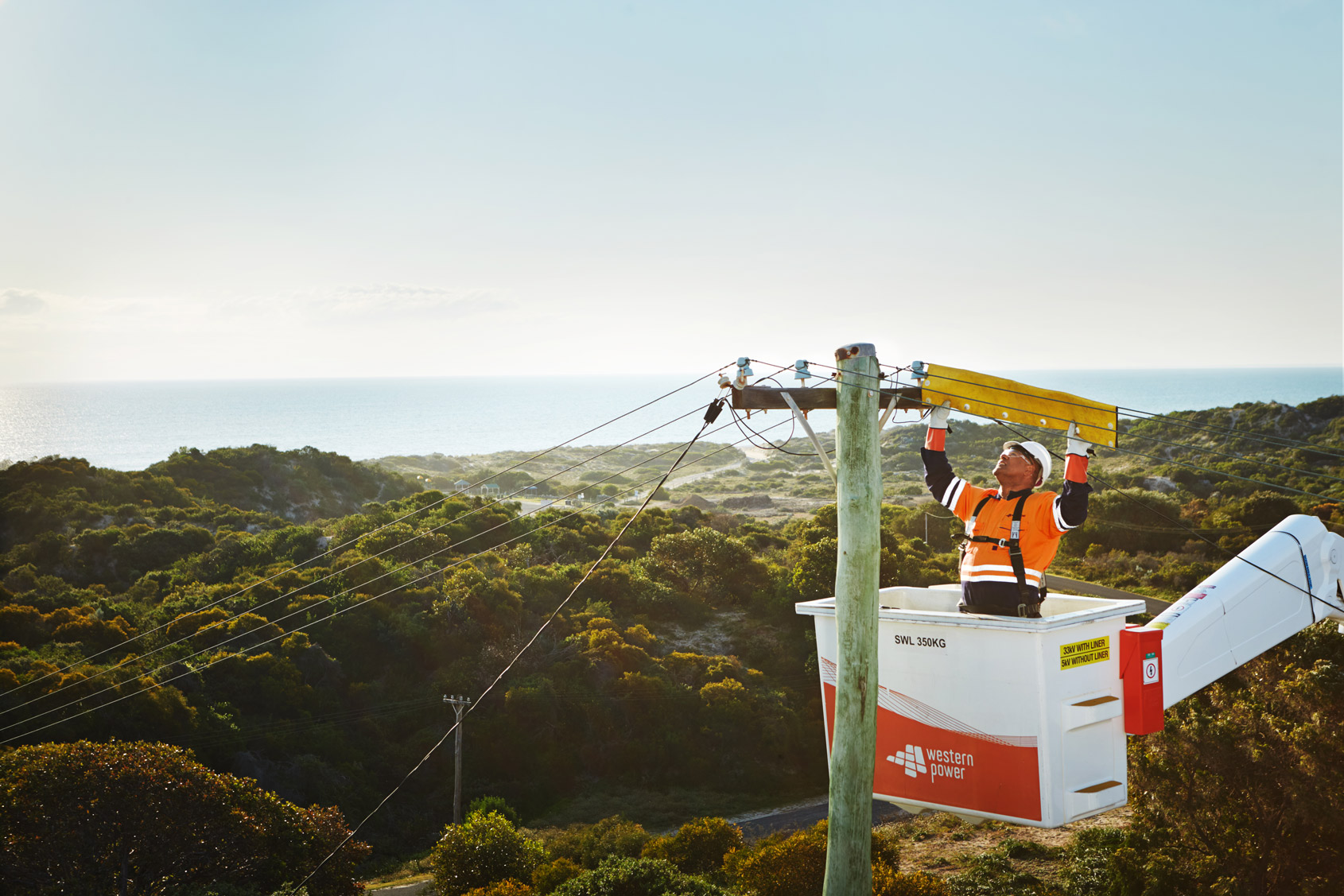
Why unplanned outages occur
Regional Western Australia presents a challenging environment to provide reliable power to our customers Due to the long distances involved, many regional towns and customers are supplied by only a single radial feeder (power line) from the substation – some of which can be up to 200km long. These lines may go through bushland and forest, across waterways, and private farmland, and may be very difficult to access. These challenges, combined with the long distances involved, means that it can take our crews a long time to locate and fix faults when they occur. These repairs may be further hindered by severe weather and fire, as our crews can’t access and restore the fault until it is safe to do so.
Localised unplanned outages are an interruption to the transmission or distribution of electricity that is unscheduled. These can be caused by storm-blown branches, wildlife, pole-top fires or bushfires anywhere along the line that trip the supply and result in an unplanned outage.
Improvements we’re making right now
In collaboration with local communities, Western Power is identifying tailored solutions that will help improve reliability in the medium to long-term.
Improvements we are making include:
- New interconnections between feeders (including normally open points) to reduce restoration times and enable backfeeding
- Installation of new Load Break Switches (LBSs) and reclosers to sectionalise long feeders and isolate faults faster
- Network reconfiguration and operability changes to reduce restoration times and enable backfeeding
- Automation of existing devices (e.g. Ring Main Units, voltage regulators and reclosers)
- Protection upgrades and optimisation to isolate faults faster and reduce the number of customers affected
- Advanced recloser controllers and communications
- Distribution Automation and Protection Reconfiguration (DAPR) system on selected feeders to automate restoration
- Installing Fuse Savers, a new, innovative device which temporarily stops power when a fault occurs, checks if the fault has resolve, and restores power if it was only a temporary issue — all without blowing the fuse.
- Replacing equipment of ageing assets following a fault (e.g. poles, conductors, equipment following faults
- Rolling out enhanced maintenance programs, such as proactively siliconing conductors on targeted feeders
- Improving SMS alerts for both planned and unplanned outages. An automated 24-hour SMS reminder for planned outages will be introduced in early 2026.
Regional areas impacted most by power supply interruptions
We understand that outages, power interruptions and major weather events cause significant frustration for residential customers and businesses. Losing power can have health and safety impacts, cut off communications, cause refrigerated produce to spoil, and even result in a loss of income. This is why Western Power is committed to improving reliability and reducing the duration of unplanned outages in regional WA.
To inform our planning, we compile data from across the South West Interconnected Network to identify the regional local government most impacted by outages. The data tells us how often the power went out in each area, how long the power was off for, and the average time power was off for each customer during an outage.
The top 10 regional local government most impacted by all power supply interruptions in 2024/25, including the necessary planned outages to address maintenance etc., are listed below. The information is based on 2024/25 data analysis and statistics.
The Shire of Victoria Plains covers about 2,569 square kilometres in the Wheatbelt region, about 160km north of Perth. About 724 customers of the Shire’s population of 802 are supplied by Western Power’s rural long feeder and 766km of overhead power lines, plus more than 4,000 distribution poles.
- Average time without power in 2025/2026 per customer: 3 days, 17 hours and 1 minute
- Average number of interruptions per year: 12.35
- Average outage duration: 7 hours and 12 minutes.
Scheduled work in 2026/2027
Replacement of:
- 52 distribution pole cross arms
- 175 insulators
- 6 overhead customer service connections
- 42 stay wires and stay insulators
- 2 surge arrestors
- 235 wood poles
- 20 luminaires (proactive)
- 2 drop out fuses
Maintenance on:
- 4 high voltage spreaders
- 2 overhead switchgears
- 108 poles and associated equipment
- 1 standalone power system
- 2 conductor clearance improvements
- 10 high voltage conductor clashing zone mitigation locations
- 275 insulators (washing and silicone program)
- 8 earthing maintenance works
- 17 emergency damage repairs
The Shire of Dalwallinu is located in the Wheatbelt region, about 250km from Perth. The area is an agricultural hub in the heart of wildflower country, with around 963 customers connected to Western Power’s electricity network.
- Average time without power in 2025/2026 per customer: 3 days, 12 hours and 55 minutes
- Average number of interruptions per year: 12.64
- Average outage duration: 6 hours and 43 minutes
Scheduled work in 2026/2027
Replacement of:
- 62 distribution pole cross arms
- 22 insulators
- 3 overhead customer service connections
- 11 stay wires and stay insulators
- 250 wood poles
- 18 luminaires (proactive)
- 1 drop out fuse
- 2 pole top transformers
Maintenance on:
- 180 poles and associated equipment
- 11 standalone power systems
- 976 insulators (washing and siliconing program)
The Shire of Coorow is a local government area located in the Mid West and Wheatbelt transition region of Western Australia, approximately 250 km north of Perth. The shire covers a large rural area that includes the towns of Coorow, Leeman, Green Head, Marchagee, and Warradarge. The shire's economy is driven by wheat, barley, canola and other broadacre crops, sheep and livestock farming, commercial and recreational fishing, particularly around Leeman and Green Head and, nature-based tourism and coastal recreation.
- Average time without power in 2025/2026 per customer: 3 days, 8 hours and 42 minutes
- Average number of interruptions per year: 5.08
- Average outage duration: 15 hours and 53 minutes
Scheduled work in 2026/2027
Replacement of:
- 30 distribution pole cross arms
- 5 dedicated metal poles
- 31 insulators
- 2 overhead customer service connections
- 21 stay wires and stay insulators
- 203 wood poles
- 12 luminaires (proactive)
- 1 drop out fuse
- 1 pole top switch
Maintenance on:
- 1 low voltage spreader
- 1 overhead switchgear
- 2 groundmounted switchgears
- 99 poles and associated equipment
- 9 standalone power systems
- 2 conductor clearance improvements
- 423 insulators (washing and siliconing program)
- 4 earthing maintenance works
The Shire of Koorda is located in the Wheatbelt region, three hours northeast of Perth on the traditional lands of the Gubrun people. Townships include Koorda, Kulja, Dukin, Mollerin and Badgerin. Grain and sheep farming are key industries, and the area is known for its granite outcrops and seasonal wildflowers.
- Average time without power in 2025/2026 per customer: 2 days, 16 hours and 37 minutes
- Average number of interruptions per year: 12.1
- Average outage duration: 5 hours and 20 minutes
Scheduled work in 2026/2027
Replacement of:
- 92 distribution pole cross arms
- 35 insulators
- 7 overhead customer service connections
- 14 stay wires and stay insulators
- 3 surge arrestors
- 339 wood poles
- 136 luminaires (proactive)
- 4 drop out fuses
- 1 pole top switch
- 1 minor asset
Maintenance on:
- 4 high voltage spreaders
- 1 low voltage spreader
- 3 automation requests for repair (RFR) devices
- 1 overhead switchgear
- 174 poles and associated equipment
- 6 standalone power systems
- 1989 insulators (washing and siliconing program)
- 23 earthing maintenance works
- 1 redundant asset removal
The Shire of Wongan-Ballidu is in the Wheatbelt region, 2.5 hours north-east of Perth on the traditional lands of the Ballardong and Yued Noongar people. Townships include Wongan Hills, Ballidu, Cadoux and several smaller communities. The area includes broadacre farmland, granite outcrops and significant areas of native vegetation.
- Average time without power in 2025/2026 per customer: 2 days, 15 hours and 25 minutes
- Average number of interruptions per year: 9.49
- Average outage duration: 6 hours and 41 minutes
Scheduled work in 2026/2027
Replacement of:
- 53 distribution pole cross arms
- 16 insulators
- 4 overhead customer service connections
- 8 stay wires and stay insulators
- 155 wood poles
- 4 luminaires (proactive)
- 1 pole top transformer
Maintenance on:
- 3 high voltage spreaders
- 69 poles and associated equipment
- 2 standalone power systems
- 9 earthing maintenance works
The Shire of Mingenew is a local government area in the Mid West region of Western Australia, centred on the town of Mingenew, approximately 110 km southeast of Geraldton and about 370 km north of Perth. It covers around 1,939 km² and has a predominantly agricultural economy. Grain production is a major industry, and the area is also known for its wildflowers, breakaway country and stargazing opportunities. Western Power’s customer base within the Shire is small but geographically dispersed across farming properties and the townsite.
- Average time without power in 2025/2026 per customer: 2 days, 13 hours and 24 minutes
- Average number of interruptions per year: 8.16
- Average outage duration: 7 hours and 32 minutes
Scheduled work in 2026/2027
Replacement of:
- 24 distribution pole cross arms
- 33 insulators
- 21 stay wires and stay insulators
- 280 wood poles
- 1 drop out fuse
- 1 pole top transformer
- 1 pole top switch
- 1 sectionaliser
Maintenance on:
- 2 overhead switchgears
- 185 poles and associated equipment
- 2 standalone power systems
- 2 conductor clearance improvements
- 554 insulators (washing and siliconing program)
- 20 earthing maintenance works
The Shire of Moora is located in the Wheatbelt, two hours north of Perth on the traditional lands of the Yued Noongar people. Townships include Moora, Miling and Watheroo. Agriculture remains a major industry, with Moora acting as a service centre for the district.
- Average time without power in 2025/2026 per customer: 2 days, 5 hours and 11 minutes
- Average number of interruptions per year: 8.9
- Average outage duration: 5 hours and 59 minutes
Scheduled work in 2026/2027
Replacement of:
- 55 distribution pole cross arms
- 24 insulators
- 28 stay wires and stay insulators
- 1 surge arrestor
- 362 wood poles
- 30 luminaires (proactive)
- 1 drop out fuse
- 3 overhead customer connections
- 2 pole top transformers
- 1 pole top switch
Maintenance on:
- 3 high voltage spreaders
- 1 overhead switchgear
- 1 groundmounted switchgear
- 207 poles and associated equipment
- 11 standalone power systems
- 1 conductor clearance improvement
- 2 high voltage conductor clashing zone mitigations
- 988 insulators (washing and siliconing program)
- 29 earthing maintenance works
The Shire of Kent is located in the Great Southern region, approximately 320 kilometres south-east of Perth. Townships include Nyabing and Pingrup. Wheat and sheep farming are key industries, alongside a landscape of lakes and broad agricultural land.
- Average time without power in 2025/2026 per customer: 2 days, 3 hours and 6 minutes
- Average number of interruptions per year: 7.45
- Average outage duration: 6 hours and 52 minutes
Scheduled work in 2026/2027
Replacement of:
- 6 distribution pole cross arms
- 11 insulators
- 1 overhead customer service connection
- 18 stay wires and stay insulators
- 154 wood poles
- 2 luminaires (proactive)
- 1 minor asset
Maintenance on:
- 49 poles and associated equipment
- 1 high voltage conductor clashing zone mitigation
- 35 insulators (washing and siliconing program)
- 3 earthing maintenance works
- 21 standalone power systems
Located in the Mid West region of Western Australia, the Shire of Chapman Valley is a local government area approximately 450 kilometers north of Perth. Covering about 3,965 square kilometers, the Shire boasts diverse landscapes, including agricultural lands, rolling hills, and coastal plains. Its economy is primarily driven by agriculture, with wheat, barley, canola, and livestock farming as the main industries. Nabawa, the main town, serves as the administrative hub, while other communities such as Yuna, Nanson, and Howatharra also contribute to the Shire's charm. Beyond agriculture, the Shire of Chapman Valley is increasingly embracing tourism, featuring many natural attractions. The Shire is dedicated to sustainable development, preserving its unique rural character while fostering economic growth and community wellbeing.
- Average time without power in 2025/2026 per customer: 1 day, 23 hours and 52 minutes
- Average number of interruptions per year: 6.87
- Average outage duration: 6 hours and 58 minutes
Scheduled work in 2026/2027
Replacement of:
- 20 distribution pole cross arms
- 24 insulators
- 1 overhead customer service connection
- 63 stay wires and stay insulators
- 484 wood poles
- 82 luminaires (proactive)
- 1 minor asset
- 1 sectionaliser
- 1 groundmounted transformer
Maintenance on:
- 1 high voltage spreader
- 1 automation requests for repair (RFR) device
- 1 overhead switchgear
- 1 groundmounted switchgear
- 64 poles and associated equipment
- 11 standalone power systems
- 1,959 insulators (washing and siliconing program)
- 6 earthing maintenance works
- 5 metal pole reinforcements
- 1 underground cable inspections
The Shire of Donnybrook Balingup is located in the South West region, approximately 206 kilometres south of Perth on the traditional lands of the Wardandi and Ganeang people of the Noongar Nation. Townships include Donnybrook, Balingup, Kirup and surrounding rural communities. The area is recognised for its orchards, vineyards, forests and agricultural heritage.
- Average time without power in 2025/2026 per customer: 1 day, 19 hours and 58 minutes
- Average number of interruptions per year: 8.38
- Average outage duration: 5 hours and 15 minutes
Scheduled work in 2026/2027
Replacement of:
- 17 distribution pole cross arms
- 37 insulators
- 2 dedicated streetlight metal poles
- 17 stay wires and stay insulators
- 70 wood poles
- 57 luminaires (proactive)
- 1 drop out fuse
- 1 pole top transformer
Maintenance on:
- 1 high voltage spreader
- 1 low voltage spreader
- 2 automation requests for repair (RFR) devices
- 1 Level C inspection of groundmounted switchgear
- 2 overhead switchgears
- 4 groundmounted switchgears
- 41 poles and associated equipment
- 5 high voltage conductor clashing zone mitigations
- 139 insulators (washing and siliconing program)
- 2 earthing maintenance works
- 16 street lights
- 2 fauna mitigations
Community updates
Service Standard Performance Report
As part of the Access Arrangement, Western Power must include service standard benchmarks for each of its reference services. These are monitored by the Economic Regulation Authority.
The Western Power - Service Standard Report - 2024/2025 contains information about the performance of the Western Power network, localised by area.
- Appendix A provides FY25 charts for each of the Service Standard Benchmarks, showing the trend of historical performance over various periods where data is available.
- Appendix B shows FY25 Reliability measures by individual feeder and by Local Government Area (LGA).
SAIDI and SAIFI
SAIDI and SAIFI are reliability metrics defined under the National Regulatory Reporting Requirements (NRRR). They help measure the overall reliability of the electricity network:
- SAIDI (System Average Interruption Duration) Index – Total number of minutes, on average, that a customer on a distribution network is without electricity in a year.
- SAIFI (System Average Interruption Frequency Index) – The average number of times a customer’s electricity supply is interrupted per year.
SAIDI Service Standard Benchmarks for Access Arrangement 5 (AA5) FY22 - FY27
| Minutes per year | |
|---|---|
| CBD | 13.7 |
| Urban | 123.8 |
| Rural Short | 202.5 |
| Rural Long | 290.0 |
SAIFI Service Standard Benchmarks for Access Arrangement 5 (AA5) FY22 - FY27
| Number per year | |
|---|---|
| CBD | 0.21 |
| Urban | 1.25 |
| Rural Short | 2.09 |
| Rural Long | 4.45 |